
The First Fleet
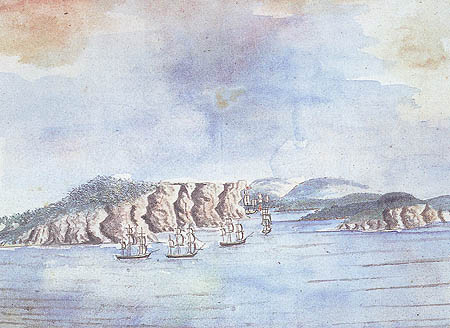
Between the years of 1788 and 1850, the British Government sent over 162,000 convicts to Australia in 806 ships. The first eleven of these ships are today known as the First Fleet and contained the convicts, marines and free settlers that are now acknowledged as the Founders of Australia.
As a result of the agrarian revolution in Britain, the population of the cities exploded which subsequently resulted in an increase in crime. The only solution to overcome the overcrowding in the jails was to establish a penal colonies else where, such as in North America. The land discovered by Captain James Cook, later known as Australia, served as the perfect solution to this problem. The convicts, military personal and free settlers would be transported there, never to return to Britain.
The Fleet consisted of six convict ships, three store ships, two men -o-war ships with a total of 756 convicts (564 male, 192 female), 550 officers/marines/ship crew and their families.
The six convict ships were:
Alexander
Charlotte
Lady Penrhyn
Friendship
Prince of Wales
Scarborough
Other ships of the Fleet were:
H.M.S. Sirius
H.M.S. Supply
The Fishburn
The Borrowdale
The Golden Grove
https://www.australianhistory.org/first-fleet
With this in mind, the British Government hired 9 ships and set about provisioning them, along with 2 Naval vessels, with enough supplies to keep the 759 convicts, their Marine guards, some with families, and a few civil officers, until they became self-sufficient.
The convicts and marines embarked on the ships, which arrived at Portsmouth on 16th March 1787. They waited on board until the arrival of Captain Arthur Phillip, which signaled the time for their departure. By this time, some convicts had been aboard these ships for seven months. Only 23 convicts died during the voyage, very few when compared to the later convict fleets.
The First Fleet left England on 13th May 1787 for the ‘lands beyond the seas’ – Australia, stopping at Tenerife, Rio de Janeiro and Cape Town, where food supplies were replenished.
The Fleet arrived at Port Jackson on the Australian East coast on 26 January 1788 after deciding that Botany Bay was not suited for a Settlement due its lack of fresh water, despite its recommendation by Captain James Cook in 1770. Botany Bay had other shortcomings as well, it was open to the sea therefore making it unsafe for the ships, and Captain Arthur Phillip (the Colony’s first Governor) considered the soil around Botany Bay was poor for crop growing.
The settlement was beset with problems from the very start. Few convicts knew how to farm and the soil around Sydney Cove was poor. Instead of the lush pastures, well watered and fertile ground that was described by Cook, the settlers found a hot, dry, infertile country unsuitable for the small farming necessary to make the settlement self-sufficient. Everyone, including Captain Phillip, was on rationed food.
The natives were wary and fearful of the settlers. Some convicts, after hearing rumours of other settlements nearby, believed that China was just over the horizon, and decided to escape. Those that managed to survive the rigors of the country returned to the colony to further punishment.
While the natives subsisted on local plants and fish, the settlers found few of the plants to be appetising. As the settlers appear to have been poor fishermen, most of their food had to come from the supplies brought with them on the ships. This resulted in their total dependence on a shipping trade monopolized by the East India Company and non-existent as far as Sydney was concerned. Rats, dogs, crows, an occasional kangaroo or emu were to be used to supplement the food.
Shelter was also a major problem in the new colony. They had very little building material and the government had provided only a very limited supply of tools, which were of a low quality. With the local trees being huge, and the wood hard, these tools were soon blunt or broken and building slowed. Extra clothing had been forgotten and, by the time the Second Fleet arrived, convicts and marines alike were dressed in patched and threadbare clothing.
By July 1788, all the ships except the Naval vessels “Syrius” and “Supply” had left and the settlement was isolated.
On 2nd October the “Syrius” was despatched to Cape Town to purchase provisions. Until her return on 2nd May 1789, rations were cut back with the result that work on farming and building was reduced. During this time the “Supply” had taken a small contingent of convicts and marines to Norfolk Island to set up another penal colony.
The land there was pronounced more fertile that Sydney Cove and the timber of better quality, but the rocky cliffs surrounding the island meant that it could not be loaded on the ship for transport to Sydney Cove. Green turtles were found there and “Supply” brought a few back on its voyages from Norfolk Island which helped to supplement the food in the colony.
Exploration of the country to the west of Sydney Cove resulted in the location of better land on the Parramatta River. A settlement was to develop there, called Rose Hill, and agriculture, although on a small scale at first, was eventually successful. But lack of transport meant that crops, when harvested, would not be readily available for Sydney.
On 19th February the “Syrius” was wrecked off Norfolk Island and the colony was left with just one ship. When the “Supply” returned in April, it was decided that she should sail to Batavia to get supplies as the situation was becoming desperate, with only 3 months supply left of some foods. On 17th April the “Supply” set sail, leaving behind very anxious settlers.
On 3rd June a ship was sighted – the “Lady Juliana”, a transport with 225 female convicts – the first of the ships in the Second Fleet. This was followed on 20th June by the “Justinian”, which was loaded entirely with provisions for the colony. Rations were immediately increased and, with the arrival of further ships carrying convicts, even though they were in very poor condition, and many died after arrival, the old labour hours were restored. New buildings were planned and large areas of land near Rose Hill were cleared for cultivation.
After more than two years of isolation and near starvation, the settlement at Sydney Cove could begin to expand, although food was to remain a major problem until after the breaking of a year long drought in late 1791, when farming began to prosper, and shipping became more regular.
It was the convicts guilty of petty crimes, that were the result of trying to survive the conditions of England at the time (eg stealing a loaf of bread), that were the pioneers of Australia, who – through hard work and perserverance, made the colony survive and expand to the stage of self sufficiency.
Can you remember all of the names of the 11 First Fleet Ships? Test your memory with the First Fleet Wordsearch.
The six convict ships were:
Alexander
Charlotte
Lady Penrhyn
Friendship
Prince of Wales
Scarborough
Other ships of the Fleet were:
H.M.S. Sirius
H.M.S. Supply
The Fishburn
The Borrowdale
The Golden Grove
Further Reading-